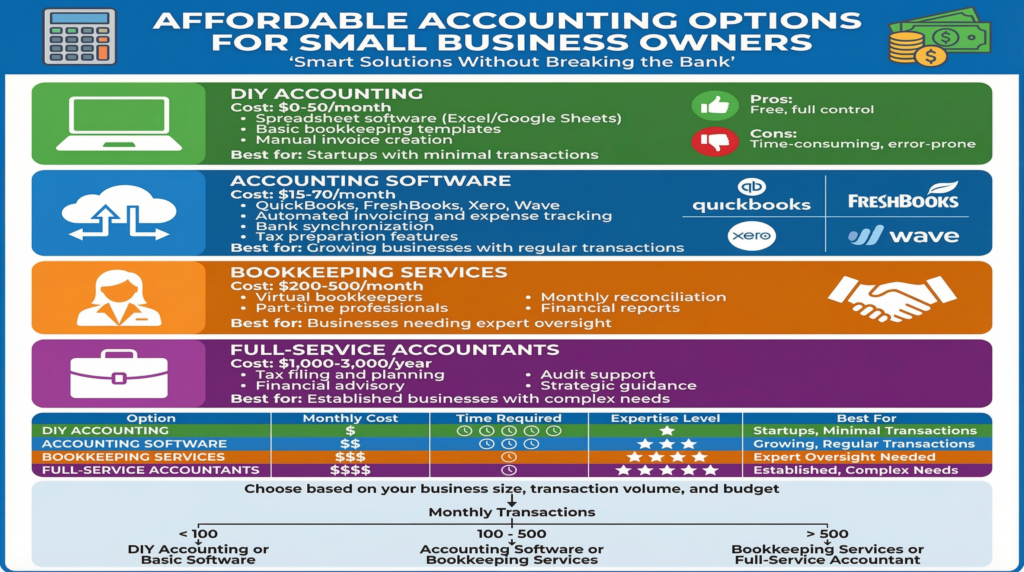
Introduction: Quality Accounting Doesn’t Have to Cost a Fortune
If you’ve ever felt that managing your business finances requires choosing between crippling costs and crippling confusion, you’re not alone. Many entrepreneurs believe professional-grade **accounting for small businesses** is a luxury reserved for established companies with deep pockets. This myth keeps countless business owners trapped in a cycle of spreadsheet chaos, tax-time panic, and financial uncertainty.
The truth is, in 2025, **affordable accounting for small businesses** is not only possible—it’s the smart standard. With the right mix of modern technology, smart processes, and strategic outsourcing, you can achieve clarity, compliance, and control over your money without it controlling you. This guide is dedicated to the bootstrapper, the side-hustler, and the growth-minded founder who needs a system that protects both their bottom line and their sanity.
Understanding the Basics: What Does “Affordable” Really Mean?
Before we dive into solutions, let’s redefine “affordable.” In accounting, affordability isn’t just about the lowest monthly subscription fee. True cost-effectiveness considers:
- Direct Costs: Software subscriptions, bookkeeper or accountant fees.
- Indirect Costs: Time spent on manual data entry, risk of errors leading to tax penalties, and opportunity cost of poor decisions due to unclear financial data.
Affordable accounting for small businesses minimizes the total cost—both monetary and operational. It’s a system that scales with you, where you pay for what you need when you need it, and technology handles the grunt work so you can focus on growth.
The Three Pillars of Affordable Accounting
- Automation: Use software to eliminate manual, repetitive tasks.
- DIY Where It Makes Sense: Handle core bookkeeping yourself with intuitive tools.
- Strategic Professional Help: Invest in expert guidance for high-stakes, high-complexity tasks like tax strategy and setup.
Key Considerations: Matching Solutions to Your Business Stage
Your path to affordable accounting for small businesses depends on your business model and complexity:
- Solo Entrepreneurs/Freelancers (Stage 1): Maximize deductions, track 1099 income, manage quarterly taxes. Free or low-cost software with invoicing and expense tracking is often sufficient.
- Small Retail/E-commerce (Stage 2): Add inventory and sales tax complexity. Paid plans with inventory management and automated sales tax are worth it.
- Restaurants & Startups with Employees (Stage 3): Introduce payroll, tip reporting, or investor reporting. Affordable accounting now means core software integrated with a dedicated payroll service. Using a specialized payroll service like Gusto or OnPay avoids catastrophic tax errors.
Your Step-by-Step Guide to Building an Affordable System
Follow this framework to create a cost-effective accounting workflow from the ground up.
Step 1: Lay the Foundation (Zero/Low Cost)
- Open a Separate Business Bank Account: Free and non-negotiable; simplifies accounting and protects personal assets.
- Adopt a Digital-First Habit: Snap photos of receipts immediately. Use free cloud storage (Google Drive, Dropbox) organized by month and category.
- Choose Your Core Tool: Start with free accounting software to understand your needs:
- Wave Accounting: Free forever for invoicing, accounting, and receipt scanning; ideal for service-based solopreneurs.
- Zoho Books: Free plan for businesses under $50K annual revenue.
- QuickBooks Self-Employed: Low-cost option for freelancers with simple tax tracking.
Step 2: Implement Your Core Workflow (Minimal Time Cost)
- Connect Your Accounts: Link business bank account and credit card for automated data feed.
- Schedule Weekly “Finance 30”: 30 minutes weekly to review and categorize transactions.
- Reconcile Monthly: Match software records with your bank statement to ensure accuracy and catch errors.
Step 3: Scale Smartly With Add-Ons (Pay Only For What You Need)
As your business grows, add integrations instead of hiring full-time staff:
- Need Inventory? Upgrade plan or use a dedicated app like TradeGecko that integrates with your software.
- Need Payroll? Add a dedicated payroll service—more affordable and compliant than manual payroll.
- Overwhelmed by Tax Prep? One-time consultation with a small business CPA can identify missed deductions and optimize setup.
Expert Tips for Maximizing Value and Minimizing Cost
- Leverage AI and Automation Rules: Auto-categorize recurring expenses and let AI learn your habits.
- Use Integrations, Not Manual Entry: Connect payment processors, e-commerce, and POS systems for automatic data flow.
- Master Key Reports: Learn to run and interpret Profit & Loss and Balance Sheet reports yourself.
- Adopt a Quarterly Tax Rhythm: Calculate and set aside taxes each quarter to avoid surprises.
- Know When to Hire Help Part-Time: A hybrid model—part-time bookkeeper 2-3 hours/month—provides expert oversight cost-effectively.
Common Mistakes That Inflate Accounting Costs
- Using Spreadsheets Too Long: Error-prone, lacks automation, time-consuming.
- Choosing the Cheapest Software, Not the Right Fit: Missing features like sales tax or inventory add inefficiency.
- Ignoring Learning Resources: Webinars, tutorials, and forums maximize the value of paid software.
- Mixing Personal and Business Expenses: Complicates bookkeeping and increases professional fees.
- Delaying Professional Advice: Paying upfront for setup is affordable; fixing messy books later is expensive.
Conclusion: Affordability is a System, Not Just a Price Tag
Building affordable accounting for small businesses is an investment in sustainability and entrepreneurial freedom.
Leverage technology for heavy lifting, focus your effort on high-value oversight, and strategically engage experts.
Start today: open that bank account, download a free app, or schedule your first “Finance 30.”
The most affordable system gives you:
- Confidence to make bold decisions
- Evidence to support growth
- Peace of mind knowing you’re in control
Ready to build that system? Exploring top-rated, cost-effective accounting software is the perfect low-risk first step.
Final Thought: True affordability isn’t measured in monthly dollars saved, but in penalties avoided, deductions captured, and opportunities seized. That’s the ultimate ROI of mastering affordable accounting for small businesses.