Introduction: Why Your Choice of Accounting System Matters More Than Ever
For a small business owner, your accounting system is far more than a digital ledger. It’s your financial co-pilot, your tax-season guardian, and the crystal ball that reveals your company’s true health. Yet, for many entrepreneurs, this critical tool is a source of immense stress—manifesting as quarterly tax panic, endless receipt piles, and the nagging uncertainty of not knowing your real profit.
In 2025, the landscape of **best accounting for small businesses** has evolved dramatically. It’s no longer just about basic bookkeeping. The top solutions now offer AI-powered insights, seamless ecosystem integrations, and industry-specific features tailored to the unique needs of freelancers, retailers, restaurateurs, and tech founders. This guide cuts through the noise to review the platforms that genuinely deserve the title of **best accounting for small businesses** this year, helping you turn a persistent pain point into your greatest strategic advantage.
Understanding the Basics: What Makes “The Best” in 2026?
Before diving into the list, it’s crucial to define our criteria. The best accounting solution for small businesses in 2025 isn’t one-size-fits-all. Instead, it’s the platform that aligns most closely with your operational needs, growth stage, and industry challenges.
We evaluated the top contenders based on these key pillars:
Industry-Specific Strength – Specialized tools for inventory management, project tracking, time management, or complex payroll requirements.
Core Functionality – Flawless invoicing, expense tracking, bank reconciliation, and comprehensive financial reporting, including Profit & Loss, Balance Sheet, and Cash Flow statements.
User Experience & Onboarding – Intuitive for non-accountants, with robust support and learning resources to help you get started quickly.
Automation & AI – Smart features like automated transaction categorization, receipt capture, and predictive cash flow insights to save time and reduce errors.
Ecosystem & Integrations – Seamless connectivity with your payment processors, e-commerce platforms, payroll services, and other business tools.
Scalability & Pricing – A flexible pricing model that grows with your business, offering advanced features without unnecessary bloat.
How to Choose: Key Considerations for Your Business Type
Your industry dictates your biggest accounting needs. Use this quick guide to focus your search:
First-Time Startup Founders
Focus on clean financials for investor reporting, burn rate tracking, and runway forecasting. Integrations with cap table management tools and scalable accounting features are key for growth and funding rounds.
Solo Entrepreneurs & Freelancers
Prioritize simple invoicing, easy expense tracking, and clear tax-season preparation. Time-tracking integrations and sleek client portals are a plus for managing multiple clients efficiently.
Retail & E-commerce Owners
Non-negotiable features include robust inventory management, seamless multi-channel sales tracking (Shopify, Amazon, etc.), and automated sales tax calculation. Strong Cost of Goods Sold (COGS) tracking is critical to understand profitability.
Restaurant & Hospitality Owners
You need daily sales reconciliation, intricate tip tracking, food inventory management, and tight integration with POS systems like Toast or Square. Accuracy and speed are essential in this fast-paced environment.
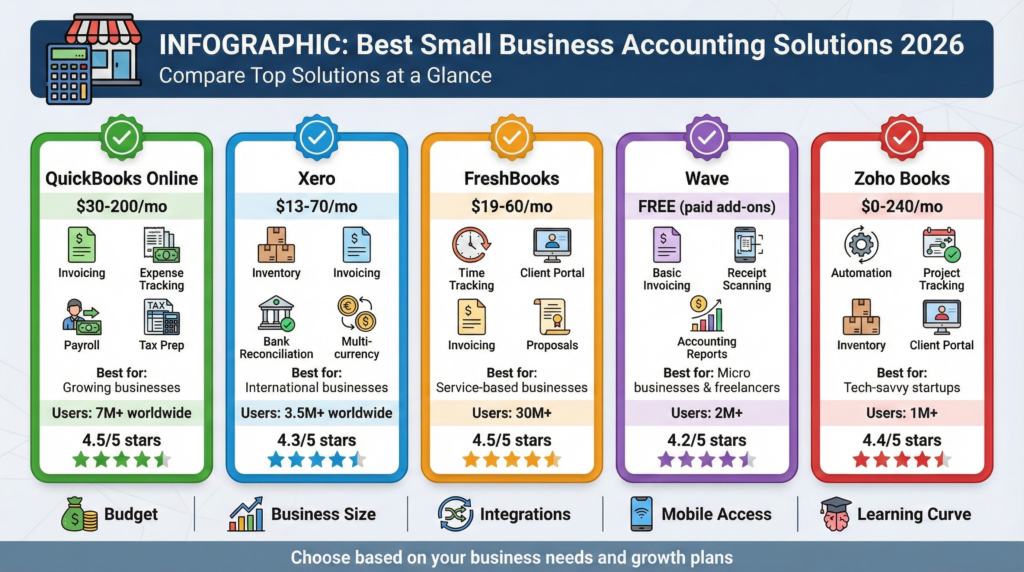
1. QuickBooks Online: The All-Around Powerhouse
Best For:
The vast majority of small businesses seeking a comprehensive, scalable, and widely-supported solution.
Why It Stands Out:
QuickBooks Online remains the industry leader for a reason. Its depth of features is unmatched, covering everything from basic bookkeeping to advanced inventory, project profitability tracking, and contractor management. Its true strength lies in its massive ecosystem—integrates with nearly every business app imaginable, from payment gateways to dedicated restaurant POS systems.
2026 Edge:
Enhanced AI capabilities that provide deeper business insights, predictive alerts, and even more automated workflows.
Ideal User:
Small business owners who expect to grow, need robust reporting, and want a solution that can connect to any tool they might adopt in the future.
For most businesses seeking the gold standard, starting a trial with QuickBooks Online is the most reliable path to streamlined finances.
2. Xero: The Collaborative Accountant’s Choice
Best For:
Businesses that work closely with an external accountant or bookkeeper, and those who value beautiful design and open API integrations.
Why It Stands Out:
Xero offers an intuitive, user-friendly interface that makes daily bookkeeping less daunting. Its collaborative nature is its superpower—built for seamless interaction between the business owner and their financial advisor. Features like unlimited users on all plans and powerful automation rules (e.g., “find & recode”) make it highly efficient.
2026 Edge:
Continued expansion of its in-app “small business services” marketplace, connecting users directly to lenders, insurance providers, and other financial services.
Ideal User:
Tech-savvy founders and creative agencies who prioritize clean design and want to foster a tight, collaborative relationship with their accountant.
3. FreshBooks: The Champion for Service-Based Businesses
Best For:
Freelancers, consultants, agencies, and any business where client billing and time tracking are central to operations.
Why It Stands Out:
FreshBooks dominates in client-facing functionality. Its invoicing engine is highly customizable, automated, and excellent for payment and late-fee tracking. Integrated time tracking and project management tools make it easy to go from a logged hour to a paid invoice. The client portal experience allows easy collaboration and document sharing.
2026 Edge:
Even smarter automated client communication for payment reminders and project updates.
Ideal User:
Solo entrepreneurs or small service-based teams whose primary pain points are getting paid on time and accurately tracking billable work.
4. Wave Accounting: The Unbeatable Free Option
Best For:
Bootstrapped solopreneurs, very small startups, and micro-businesses with straightforward finances who need a powerful, zero-cost entry point.
Why It Stands Out:
Its price tag—completely free for accounting, invoicing, and receipt scanning. For a free tool, its feature set is robust, handling all core bookkeeping efficiently. Ideal for starting professional bookkeeping habits without financial commitment.
Important Note:
Wave makes money through optional paid add-ons for payroll and payment processing, which may be necessary as the business grows.
2026 Edge:
Refined mobile app for on-the-go receipt capture and invoice sending.
Ideal User:
Just-starting freelancers or side-hustlers who need professional tools on a minimal budget. Perfect as a proof-of-concept platform.
5. Zoho Books: The Integrated Ecosystem Player
Best For:
Businesses already using Zoho’s suite of products (CRM, Desk, Mail) or those desiring deeply integrated, all-in-one business management from a single vendor.
Why It Stands Out:
Zoho Books offers strong automation, inventory, and client portal features. Its key advantage is native integration with other Zoho applications, creating a seamless flow from CRM leads → projects → invoices → books, eliminating data silos.
2026 Edge:
Advanced AI (Zia) provides contextual assistance, anomaly detection, and intelligent chat support.
Ideal User:
Small businesses committed to or considering the Zoho ecosystem for a unified, cost-effective approach to managing their entire operation.
Expert Tips for Implementation Success
Choosing the platform is only half the battle. Successful implementation is key.
- Start Clean:
Begin using your new software at the start of a financial quarter or tax year. If migrating mid-cycle, consider hiring a professional bookkeeper for a one-time setup to ensure your opening balances are correct and your chart of accounts is optimized. - Connect Everything:
Link your business bank accounts, credit cards, and payment processors immediately. Automation is your greatest time-saver. - Categorize Relentlessly:
Spend time upfront setting up expense categories correctly. Consistent categorization ensures accurate tax deductions and clear financial reports. - Use the Mobile App Religiously:
Snap photos of receipts the moment you get them. Log mileage instantly. This prevents the dreaded “receipt shoebox.” - Schedule Weekly “Finance Time”:
Block 30 minutes each week to review transactions, send invoices, and check your cash flow dashboard. Consistency prevents month-end chaos.
Common Mistakes to Avoid When Choosing Accounting Software
- Choosing Based on Price Alone:
The cheapest option may lack critical features, costing you more in manual labor or errors down the line. - Ignoring Scalability:
Avoid migrating to a new system in 18 months because your starter platform is no longer sufficient. - Overbuying Features:
A complex enterprise solution can overwhelm a solo freelancer. Start simple and upgrade as necessary. - Neglecting the Learning Curve:
Factor in training time. Powerful software is useless if you don’t know how to use it. Many top platforms offer expert-led onboarding; investing in training unlocks full potential from day one. (CTA 3) - Forgetting About Payroll:
If you have employees, ensure your software includes strong payroll features or integrates seamlessly with services like Gusto or ADP. Payroll errors are costly; automated payroll integration is a safeguard no growing business should skip. (CTA 4)
Conclusion: Taking Control of Your Financial Future
The search for the best accounting for small businesses in 2025 ends with a simple truth: the best platform is the one you will use consistently.
It should reduce administrative burden, not add to it. It should provide clarity, not confusion.
- QuickBooks Online: Most complete and scalable toolkit.
- FreshBooks: Ideal for service-based businesses.
- Xero: Perfect for seamless collaboration with accountants.
- Wave: Risk-free launchpad for beginners.
Investing in the right system is an investment in peace of mind and strategic intelligence. By automating tedious accounting tasks, you free up your most valuable asset—time and focus—to grow your business.
Ready to experience the relief of organized finances? Comparing top-rated options side-by-side is the fastest way to find your perfect match.