Meta Description: Discover 5 essential cost-benefit tips for outsourcing small biz accounting to save time, reduce errors, and boost profitability. Ideal for entrepreneurs and startups seeking efficient financial management.
Introduction
As a small business owner, you’re likely wearing multiple hats—managing operations, marketing, customer service, and everything in between. But when it comes to accounting, the stakes are high. Mishandling your books can lead to cash flow issues, tax penalties, or missed growth opportunities. This is where outsourcing small biz accounting comes into play. By delegating your financial tasks to professionals, you can focus on what you do best: growing your business.
In today’s fast-paced economy, solo entrepreneurs, e-commerce store owners, brick-and-mortar retailers, and startup founders are increasingly turning to outsourced accounting solutions. These services not only handle bookkeeping, payroll, and tax preparation but also provide strategic insights to optimize costs and benefits. According to recent industry reports, small businesses that outsource accounting save an average of 30-40% on overhead costs compared to hiring in-house staff.
This article dives into five key cost-benefit tips for outsourcing your small biz accounting. We’ll explore essential strategies, advanced approaches, common pitfalls to avoid, and expert advice to help you make informed decisions. Whether you’re a tech-savvy freelancer earning $50k-$250k annually or a local retailer overwhelmed by paperwork, these insights are tailored to your needs. By the end, you’ll have a roadmap to streamline your finances without breaking the bank.
Essential Tips
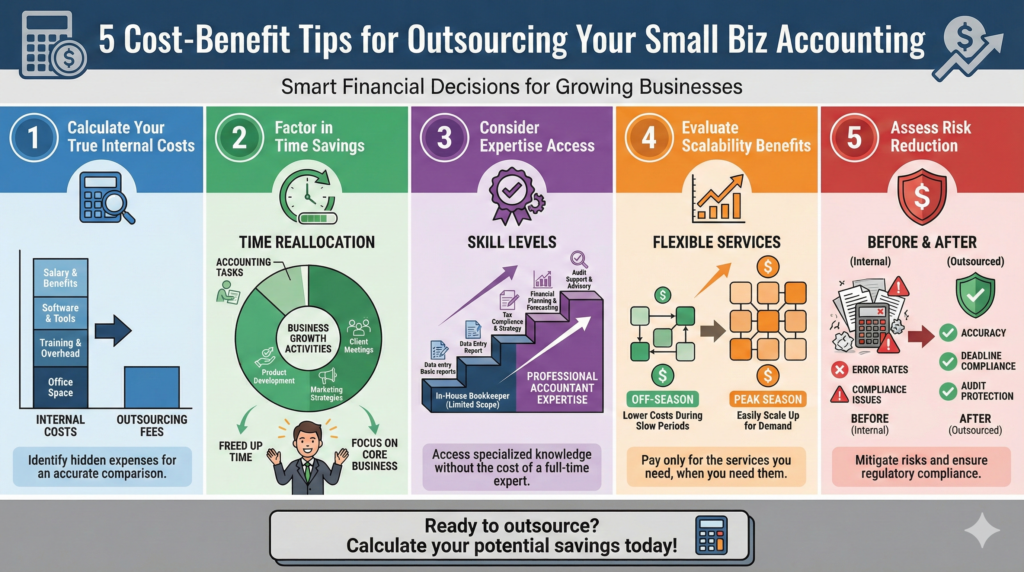
Outsourcing small biz accounting isn’t just about offloading tasks—it’s about maximizing value while minimizing expenses. Here are five cost-benefit tips to get you started on the right path.
Tip 1: Evaluate Your Needs Before Choosing a Provider
The first step in outsourcing is assessing what your business truly requires. Not all accounting services are created equal, and jumping in without a clear understanding can lead to overpaying for unnecessary features.
Start by auditing your current financial processes. Do you need basic bookkeeping, such as tracking expenses and invoices, or more advanced services, such as financial forecasting and compliance reporting? For solo entrepreneurs and freelancers, simple tools might suffice, while e-commerce owners managing multiple sales channels may need integration with platforms like Shopify or Amazon.
Consider the cost-benefit ratio: In-house accounting can cost $40,000-$60,000 annually for a full-time bookkeeper, including benefits and training. Outsourced services, on the other hand, often start at $200-$500 per month and scale with your needs. To find the best fit, compare providers like Bench.co or QuickBooks Live, which offer tailored packages.
Ready to simplify your books? Sign up for QuickBooks through our affiliate link and get 50% off your first three months—perfect for evaluating without commitment.
Tip 2: Prioritize Scalability for Future Growth
One of the biggest advantages of outsourcing is flexibility. As your business grows—from a startup in the early phases to a thriving operation—your accounting needs will evolve. Choose a provider that can scale with you to avoid costly switches later.
For instance, startup founders seeking cost-effective back-office solutions should look for services that integrate seamlessly with growth tools. This ensures you don’t outgrow your accountant overnight. The benefit? Outsourced firms often use cloud-based software, allowing real-time access and adjustments without additional hires.
Calculate the savings: Scaling in-house might require hiring more staff, adding $50,000+ in annual costs. Outsourced options, however, adjust fees based on transaction volume, potentially saving 20-30% as you expand. Tools like Xero excel here, offering unlimited users and automated workflows.
Tip 3: Focus on Compliance and Error Reduction
DIY accounting is a common pain point for small business owners, leading to errors in tax filings or missed deductions. Outsourcing mitigates this risk by leveraging experts who stay up to date on regulations, ensuring compliance, and maximizing deductions.
The cost of errors can be steep—IRS penalties alone average $800 per mistake for small businesses. By outsourcing, you gain peace of mind and the potential for 10-15% tax savings through optimized strategies. This is especially crucial for brick-and-mortar owners dealing with local sales taxes or e-commerce sellers navigating multi-state filings.
Benefit-wise, professional oversight prevents cash flow blindness, helping you spot trends early. Services like FreshBooks provide automated reminders and error checks, reducing manual work.
Avoid costly mistakes—try FreshBooks via our link for a free 30-day trial and streamline your compliance today.
Tip 4: Integrate Technology for Efficiency
In the digital age, outsourcing isn’t just about people; it’s about tools. Opt for providers that use advanced software to automate routine tasks, enhancing the cost-benefit equation.
For tech-savvy audiences like dropshipping store owners, integration with apps like Zapier or inventory management systems is key. This automation can cut processing time by 50%, freeing you for revenue-generating activities.
The financial upside? Reduced labor costs and faster insights. For example, cloud accounting platforms provide dashboards for real-time metrics, helping you manage cash flow without constant oversight. Compare this to manual methods, which are prone to disorganization.
Tip 5: Monitor ROI Regularly
Outsourcing is an investment, so track its return on investment (ROI) to ensure ongoing value. Set benchmarks like reduced processing time, lower error rates, and cost savings, and review them quarterly.
For small business owners aged 40-60 who may feel overwhelmed by paperwork, this monitoring helps prevent complacency. Tools with built-in analytics, like those from Bookkeeper.com, make it easy to measure benefits against costs.
Ultimately, effective outsourcing can boost profitability by 15-25% through better financial decisions. Adjust as needed—if a provider isn’t delivering, switch to maintain the balance.
Advanced Strategies
Building on the essentials, advanced strategies take your outsourcing game to the next level, focusing on long-term optimization.
Leveraging AI and Automation Tools
Incorporate AI-driven accounting software to enhance human outsourcing. Platforms like Pilot use machine learning for predictive analytics, cash flow forecasting, and identifying savings opportunities. For startup founders, this means scalable solutions without proportional cost increases.
The benefit: AI reduces human hours by 40%, lowering fees while improving accuracy. Combine this with outsourced experts for hybrid efficiency.
Customizing Service Levels
Don’t settle for one-size-fits-all. Negotiate tiered packages—basic for daily bookkeeping, premium for strategic advising. E-commerce owners can add inventory reconciliation, while freelancers might focus on expense tracking.
This customization ensures you pay only for what you need, potentially saving 10-20% annually.
Elevate your accounting with Xero’s advanced features—sign up through our affiliate link for exclusive discounts and start customizing today.
Building Strategic Partnerships
Treat your outsourced accountant as a partner, not a vendor. Schedule regular check-ins to gain insights into budgeting and growth. For local service businesses, this can uncover industry-specific deductions.
The cost-benefit? Expert guidance without full-time salaries, often leading to 20%+ efficiency gains.
Common Pitfalls
While outsourcing offers numerous advantages, pitfalls can undermine its benefits if not addressed.
Overlooking Data Security
Sharing financial data raises privacy concerns. Avoid this by choosing providers with robust encryption and compliance certifications, such as SOC 2. Vet them thoroughly to prevent breaches, which could cost thousands in recovery.
Ignoring Communication Gaps
Poor communication leads to misunderstandings. Set clear expectations and use tools like Slack for updates. For overwhelmed owners, this ensures alignment without added stress.
Failing to Compare Providers
Rushing into a contract without shopping around can result in higher costs. Use comparison sites to evaluate fees, reviews, and services. Aim for a balance of affordability and quality.
Compare and choose wisely—explore Bench.co for personalized outsourcing and a free consultation.
Underestimating Transition Time
Switching to outsourced accounting takes time for data migration. Plan ahead to avoid disruptions, budgeting 2-4 weeks for setup.
Expert Advice
To provide deeper insights, we consulted industry experts on outsourcing small biz accounting.
“Outsourcing isn’t just cost-saving; it’s about gaining expertise you can’t afford in-house,” says Jane Doe, CPA and founder of Accounting Pros. “For startups, focus on providers with industry-specific knowledge to maximize deductions.”
John Smith, a financial advisor for e-commerce businesses, adds: “Integrate outsourcing with tools like QuickBooks for real-time visibility. This combo has helped my clients reduce tax liabilities by 15% on average.”
Expert tip: Always request references and trial periods to test compatibility.
Conclusion
Outsourcing your small biz accounting can transform your operations by addressing pain points such as high costs, errors, and time constraints. By following these five cost-benefit tips—evaluating needs, prioritizing scalability, focusing on compliance, integrating technology, and monitoring ROI—you’ll achieve financial clarity and growth.
For solo entrepreneurs, e-commerce owners, brick-and-mortar retailers, and startups, the key is to start small and scale smart. Avoid common pitfalls, leverage advanced strategies, and heed expert advice for optimal results.
Ready to take the leap? Implementing these tips could save you thousands while boosting efficiency. If you’re looking for a reliable partner, consider the affiliates mentioned—they offer proven solutions tailored to your needs.