Meta Description
Discover the best accounting software for small businesses in 2026. This guide covers key features, selection tips, and top picks to simplify taxes, expenses, and financial tracking.
1. Introduction
Running a small business is a thrilling adventure—but simplifying your finances unlocks control and peace of mind. Whether you’re a solo freelancer streamlining client invoicing, a retail owner gaining clarity with organized inventory and sales tax, a restaurant operator easily managing payroll and tips, or a startup founder confidently building your first profit and loss statement, organized accounting empowers informed decisions. Instead of dreading tax deadlines or puzzling over reconciliations, know your business’s true health every day.
That’s where accounting software steps in as a game-changer. In today’s digital world, the right tool automates tedious tasks, slashes costly errors, and delivers instant financial clarity—so you can make smarter decisions faster. This guide is for entrepreneurs like you—tech-savvy freelancers aged 25-45 in creative fields, e-commerce owners aged 30-55 buried in paperwork, hospitality pros aged 35-60 managing daily cash flows, and first-time founders aged 22-40 with more product expertise than financial know-how. We’ll cover everything from basics to expert tips, helping you master small business accounting confidently.
By the end, you’ll know how to select software that eliminates your fear of tax penalties and simplifies expense categorization. Next, we’ll cover the essentials of accounting software so you can confidently empower your business to thrive financially.
2. Understanding the Basics
Before choosing accounting software, it’s essential to know how it transforms daily business tasks. Accounting software tracks financial data, automates routine processes, and increases accuracy, replacing manual spreadsheets with seamless workflows for compliance and efficiency.
For small businesses, effective accounting isn’t just about numbers. It also brings visibility into your operations. Imagine a freelancer sending invoices that automatically track payments, or a restaurant owner generating payroll reports that account for tips without hours of manual entry. According to industry experts, these tools can save up to 20 hours monthly on administrative tasks. That frees you to focus on growth.
Key components include:
- Bookkeeping Essentials: Recording transactions, managing ledgers, and reconciling bank statements.
- Reporting Tools: Generating profit and loss (P&L) statements, balance sheets, and cash flow reports to assess business health.
- Tax Compliance: Automating calculations for deductions, sales tax, and filings to avoid penalties.
In 2026, cloud-based options dominate, offering accessibility from any device. After reviewing what accounting software does, let’s look at the key considerations to keep in mind when making your choice.
3. Key Considerations
Selecting the right accounting software requires evaluating several factors tailored to your business type and pain points. Here’s what to prioritize:
3.1 Ease of Use and User Interface
As a busy entrepreneur, you don’t want software that requires an accounting degree. Look for intuitive dashboards, drag-and-drop features, and mobile apps for on-the-go access. For instance, freelancers in creative industries benefit from simple invoicing, while restaurant owners need quick cash flow tracking.
3.2 Core Features and Functionality
Essential features include invoicing, expense tracking, payroll, inventory management, and automated bank reconciliations. Advanced options like multi-currency support or AI-driven insights are bonuses for growing startups. Make sure it integrates with tools you already use, such as e-commerce platforms like Shopify or payment processors like Stripe.
3.3 Scalability and Customization
Your business won’t stay small forever. Choose software that grows with you. It should add users, handle more transactions, or support multiple locations. Customizable reports and workflows are key for e-commerce owners managing sales tax across states.
3.4 Cost and Pricing Models
Budget is critical. Free options like Wave suit microbusinesses, while paid plans (starting at $15-30/month) offer more features. Factor in hidden costs, such as payroll add-ons or additional users. PCMag highlights that affordable tools like FreshBooks provide excellent value for service-based businesses.
3.5 Security and Compliance
With data breaches on the rise, bank-level encryption and automatic backups are essential. Compliance with tax laws—such as IRS standards—is critical to avoid penalties from quarterly filings.
3.6 Customer Support and Integrations
Reliable support—via chat, phone, or tutorials—is vital for first-time users. Seamless integrations with CRM, HR, or banking apps can streamline your operations.
By weighing these factors, you’ll find software that addresses your specific challenges, such as accurate P&L statements for better decision-making.
4. Step-by-Step Guide
Choosing accounting software doesn’t have to be daunting. Follow this practical guide to make an informed decision:
4.1 Assess Your Business Needs
Start by listing your pain points. Are you overwhelmed by taxes? Do you struggle with expense categorization? For retail owners, inventory tracking is key. For hospitality, payroll complexity matters. Survey your team or accountant for input.
4.2 Research Top Options
Based on 2026 reviews, top picks include:
- QuickBooks Online: Ideal for comprehensive needs, with strong inventory and reporting. ZDNET calls it the best overall for its balance of features and usability. Ready to streamline your finances? Sign up for QuickBooks Online and get 50% off your first three months.
- FreshBooks: Perfect for freelancers and service-based businesses, emphasizing invoicing and time tracking. PCMag praises its design for microbusinesses.
- Xero: Great for growing teams with unlimited users and global support. CNBC notes its affordability. Try Xero today for a free trial.
- Zoho Books: User-friendly with free plans for low-revenue businesses. SoftwareReviews ranks it highly for ease.
- Wave: Best free option for basics like invoicing. U.S. Chamber recommends it for solopreneurs.
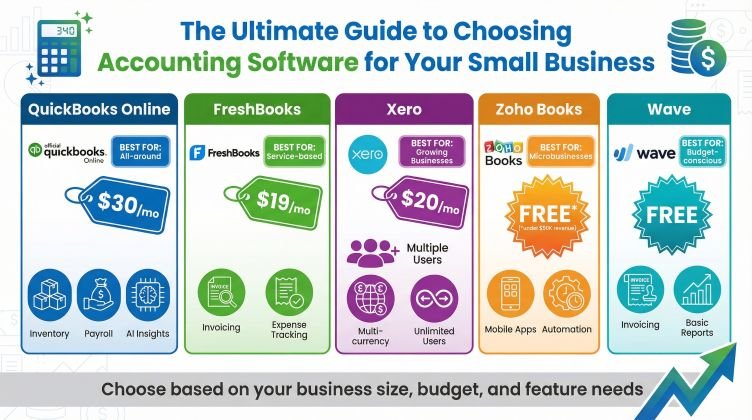
Compare using tables:
| Software | Best For | Starting Price | Key Features |
| QuickBooks Online | All-around | $30/month | Inventory, payroll, AI insights |
| FreshBooks | Service-based | $19/month | Invoicing, expense tracking |
| Xero | Growing businesses | $20/month | Unlimited users, multi-currency |
| Zoho Books | Microbusinesses | Free (under $50K revenue) | Mobile apps, automation |
| Wave | Budget-conscious | Free | Invoicing, basic reports |
4.3 Test and Demo
Sign up for free trials (most offer 14-30 days). Import sample data to simulate your workflows, like reconciling statements or generating P&L reports.
4.4 Evaluate Support and Training
Check reviews for support quality. Opt for tools with tutorials or onboarding help.
4.5 Make the Purchase and Implement
Once you decide, migrate your data carefully. Train yourself or your staff to avoid disruptions.
Following this process ensures the software fits your unique setup. Now, take your strategy further with expert tips that can help you get even more out of your accounting solution.
5. Expert Tips
Leverage these insights from industry sources to maximize your choice:
- Automate Where Possible: Use AI features for expense categorization to reduce deduction errors. NetSuite emphasizes automation for core tasks, such as invoicing.
- Integrate with Other Tools: Connect to banking apps for real-time reconciliations, easing bank statement headaches.
- Focus on Mobile Access: For on-the-go owners like restaurant managers, mobile apps are essential. Chase highlights this for small businesses.
- Plan for Growth: Choose scalable options to avoid switching later. Workday advises evaluating delivery models for expansion.
- Monitor Cash Flow Daily: Use dashboards for quick insights into business health.
- Get Professional Advice: Consult an accountant early to ensure compliance.
Explore FreshBooks for seamless invoicing—sign up for exclusive discounts.
These expert insights help you turn accounting software into a valuable business asset. Next, be aware of common mistakes small businesses make when choosing accounting software and learn how to avoid them.
6. Common Mistakes
Avoid these pitfalls to prevent costly regrets:
6.1 Ignoring Specific Needs
Don’t pick generic software; assess whether it handles your industry, such as e-commerce inventory. Akaunting warns against failing to evaluate requirements.
6.2 Choosing Price Over Quality
Cheap options may lack features or security. Nordic Backup notes that this leads to glitches and privacy issues.
6.3 Skipping Training
Lack of employee training causes errors. Reach Technologies highlights this as a key oversight.
6.4 Neglecting Automation
Manual processes invite calculation errors. Hiscox recommends automating to improve accuracy.
6.5 Forgetting Scalability
On-premises software can limit growth. PCMag advises against it for most businesses.
By sidestepping these mistakes, you’ll select a tool that truly supports your business. As we wrap up, let’s review how choosing the right accounting software leads to ongoing financial clarity and growth.
7. Conclusion
Choosing the right accounting software is a pivotal step toward financial clarity and growth for your small business. From alleviating tax fears to simplifying expense tracking and P&L generation, the options we’ve covered—like QuickBooks, FreshBooks, and Xero—can transform your operations. Remember, the best choice aligns with your audience’s needs, whether you’re a freelancer or a restaurant owner.
Take action today: Assess your requirements, test a few tools, and invest in one that scales with you. For a strong start, check out Zoho Books for free access if your revenue is under $ 50 K. And if you’re budget-focused, try Wave’s free plan.
With the right software, accounting for small businesses becomes an asset rather than a burden. Here’s to your success in 2026 and beyond!