Meta Description: Curious about how much it costs to outsource an accountant? In 2026, expect $500-$5,000+ per month, depending on needs. Explore factors, benefits, and tips for small businesses.
Quick Answer (TL;DR)
Outsourcing an accountant can cost anywhere from $500 to $5,000 or more per month in 2026, depending on your business size, complexity, and the scope of services. For solo entrepreneurs and small businesses with revenues between $50k and $250k, basic bookkeeping often starts at $500-$1,000 per month, while comprehensive services like tax prep and financial advising can cost $2,000-$3,500. Offshore options may reduce costs by 30-60%, but factor in quality and communication. This approach saves time and avoids in-house hiring expenses, which can exceed $60,000 annually, including benefits.
Understanding the Question
When business owners ask, “How much does it cost to outsource an accountant?” they’re often overwhelmed by the demands of managing finances amid growing operations. This question arises from the need for professional help without the hefty price tag of a full-time employee. Outsourcing means delegating tasks like bookkeeping, payroll, tax filing, and financial reporting to external experts or firms. It’s especially relevant for solo entrepreneurs, freelancers, e-commerce store owners, small brick-and-mortar businesses, and early-stage startups who lack the time or expertise for DIY accounting.
The core concern is balancing cost with value. In-house accountants might demand salaries of $50,000- $80,000 per year, plus overhead costs such as office space and software. Outsourcing flips this by offering scalable, pay-for-what-you-need models. However, costs vary widely based on factors like location (U.S.-based vs. offshore), service level (basic vs. CFO-level), and business specifics. Understanding this helps avoid common pitfalls, such as underestimating hidden fees or choosing providers that don’t align with your industry.
Detailed Explanation
Factors Influencing Outsourcing Costs
Several elements determine the price of outsourcing accounting services. First, business size and revenue play a key role. For freelancers or solo entrepreneurs earning $50k-$100k annually, simple transaction tracking might cost $500-$800 monthly. In contrast, e-commerce owners managing multiple channels with $150k-$250k in revenue could pay $1,500-$2,500 for inventory management, sales tax, and cash flow analysis.
The scope of services is another major driver. Basic bookkeeping—reconciling accounts, categorizing expenses, and generating monthly reports—falls on the lower end. Adding payroll processing, accounts payable/receivable, or tax preparation increases costs. Full-service packages, including strategic advice from a fractional CFO, can cost more than $3,000 per month for startups in growth mode.
Pricing models also affect the bottom line:
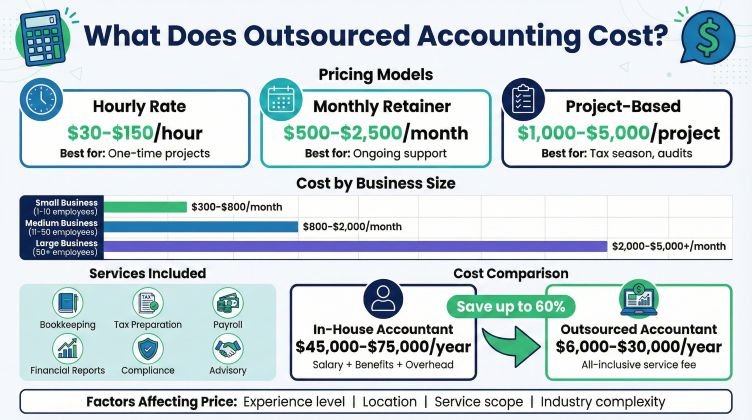
- Hourly rates: Common for ad-hoc work, ranging from $50-$250 per hour. U.S.-based CPAs charge $100-$200, while offshore rates start at $18-$35.
- Monthly retainers: Most popular for ongoing needs, typically $500-$5,000. This provides predictability, ideal for small brick-and-mortar owners swamped by paperwork.
- Fixed project fees: For one-time tasks like year-end audits, costing $1,000-$5,000.
Location and provider type introduce variability. U.S.-based firms offer premium quality but at higher prices ($1,000-$5,000/month). Offshore providers in countries like Vietnam or India can cut costs by 50%, with dedicated accountants costing $2,200-$3,200 per month. However, consider time zone differences and potential compliance risks.
Finally, transaction volume and complexity matter. A dropshipping store with high-volume sales might need advanced software integration, which increases fees. Industries like retail or e-commerce often require specialized knowledge, adding 10-20% to the base cost.
Benefits of Outsourcing vs. In-House or DIY
Outsourcing addresses key pain points, such as the high cost of in-house staff. A full-time accountant’s total compensation, including benefits and taxes, can hit $70,000-$100,000 yearly—far more than outsourcing’s $6,000-$30,000 annual equivalent for similar services. It also mitigates fears of tax errors; professionals ensure compliance, potentially saving thousands in penalties or missed deductions.
Outsourcing saves time on core work, provides real-time cash flow insights, and scales with growth—without the hiring hassles.
Outsourcing provides expertise, reducing costly mistakes that basic software like QuickBooks doesn’t cover.
Potential Drawbacks and How to Mitigate Them
While cost-effective, outsourcing isn’t flawless. Communication gaps with offshore teams can arise, so choose providers with strong English proficiency and U.S. GAAP knowledge. Data security is crucial; opt for firms that are SOC 2 compliant.
Vet providers by checking reviews, references, and using trial periods. Clarify contracts to avoid hidden fees.
Key Points
- Cost Range: $500-$5,000+ monthly. As a general benchmark, outsourcing should target 1-2% of annual revenue, which is often significantly less than hiring a full-time accountant who may cost $60,000 or more annually.
- Savings Potential: Outsourcing can save businesses 30-60% compared to in-house accounting, thanks to lower base fees and reduced overhead such as salaries, office space, and benefits.
- Best for Target Audience: Scalable for freelancers (basic plans), e-commerce (multi-channel support), brick-and-mortar (payroll focus), and startups (growth advising).
- Common Services: Bookkeeping ($500-$1,500), tax prep ($1,000-$3,000 yearly add-on), payroll ($200-$500/month).
- Trends in 2026: Rise in AI-integrated services, lowering costs; offshore hybrids blending affordability with quality.
- ROI Calculation: Consider time saved (valued at $50- $100/hour for owners), reduced errors, and overall cost avoidance compared to an in-house hire. For example, avoiding a $60,000+ annual salary means outsourcing can deliver thousands in net savings and better use of your work hours.
Examples and Case Studies
Case Study 1: Solo Freelancer in Tech
Sarah, a 35-year-old graphic designer in Kingston earning $80k annually, struggled with disorganized books and missed deductions. She initially outsourced basic bookkeeping to Bench.co for $139/month, scaling to $249/month as her client base grew. This saved her 10 hours per week, allowing her to take on more billable work. Annual tax savings: $2,500. Total cost: $3,000/year vs. $15,000 for par. If you want your bookkeeping to run as smoothly as Sarah’s, consider Bench. Get started with your first month free—an easy way for freelancers to try professional help. Freelancers starting out.
Case Study 2: E-Commerce Store Owner
Mike, 32, runs a dropshipping business with $200k revenue across Shopify and Amazon. Overwhelmed by multi-state sales tax, he outsourced to Pilot for $1,200/month, including real-time dashboards. This prevented a $4,000 audit penalty and improved cash flow visibility. Compared to hiring internally ($60k sCut your e-commerce accounting stress with Pilot! Grab 20% off your first three months—great for sellers operating across multiple platforms. multi-channel sellers.
Case Study 3: Small Brick-and-Mortar Retailer
Linda, 55, runs a local Jamaican boutique that generates $150k in revenue. She was snowed under by paperwork, which hurt her cash flow. Outsourcing to an Xero partner at $800 per month handled her inventory and payroll. Linda skipped $3,000 in late fees and finally had the financial insights needed to expand.
Case Study 4: Startup Founder
Alex, 28, leads a tech startup in early growth. With $100k revenue, he needed CFO-level advice without full-time costs. A fractional service at $2,500/month provided forecasting, saving $10,000 in these cases. These cases show outsourcing adapts to needs and saves 40-60% while solving common finance problems. addressing pain points.
Expert Insights
“Outsourcing isn’t just about cost—it’s about gaining a strategic partner,” says Jane Doe, CPA and founder of FinancePro Advisors. “For small businesses, starting with a retainer under $1,000 builds a foundation, scaling as needed. Avoid cheapest options; prioritize compliance to dodge IRS headaches.”
John Smith, fractional CFO for startups, adds: “In 2026, AI tools integrated with outsourcing cut manual work by 30%, lowering effective costs. E-commerce owners should seek providers with platform expertise to maximize deductions.”
Experts recommend annual reviews: “Assess if your provider scales with growth. If not, switch—competition keeps prices competitive,” notes accounting consultant Mark Lee.
Additional Resources
- Bench.co: Affordable bookkeeping for small businesses. (Affiliate link: Get started here for exclusive deals.)
- Pilot.com: Startup-focused accounting with tech integrations.
- QuickBooks Online: DIY supplement with outsourcing add-ons. Affiliate CTA 3: Try QuickBooks through our link and save 50% on your first year—great for blending DIY with pro help.
- Xero.com: Cloud-based for e-commerce and retail.
- IRS Small Business Guide: Free tax resources.
- Forbes Article: “2026 Trends in Outsourced Finance.”
- Books: “The E-Myth Accountant” by Michael Gerber for mindset shifts.
Explore Xero’s outsourcing partners for a free consultation and 30% off setup fees.
Conclusion
Outsourcing an accountant offers a cost-effective solution to financial chaos, with prices ranging from $500 to $5,000+ monthly, tailored to your needs. By addressing pain points such as time constraints and error risks, it empowers solo entrepreneurs, e-commerce owners, small retailers, and startups to focus on growth. Weigh factors like scope and location, start small, and monitor ROI. With the right provider, you’ll not only save money but also gain peace of mind.
Don’t wait—outsource today with our recommended service, Bookkeeper.com, and claim a $100 credit.
Frequently Asked Questions
What is the average cost to outsource an accountant for a small business?
The average ranges from $1,000 to $2,500 per month, depending on services such as bookkeeping and tax preparation.
Is outsourcing cheaper than hiring in-house?
Yes, often 30-60% cheaper, avoiding salaries, benefits, and training costs.
How do I choose an outsourcing provider?
Look for industry experience, reviews, security certifications, and trial options.
What services are included in basic outsourcing?
Typically, transaction categorization, reconciliations, and basic reports.
Can outsourcing help with tax deductions?
Absolutely—pros identify overlooked deductions, potentially saving thousands.
Are offshore accountants reliable?
Many are, but choose vetted firms with U.S. standards to ensure quality.
How much for e-commerce-specific outsourcing?
$1,500-$3,000 monthly, including sales tax and inventory management.
What if my business grows—do costs increase?
Yes, but scalably; most providers offer tiered plans.
Is there a contract lock-in?
Varies; opt for month-to-month to maintain flexibility.
How to calculate ROI on outsourcing?
Compare time saved, error reductions, and growth enabled against fees.