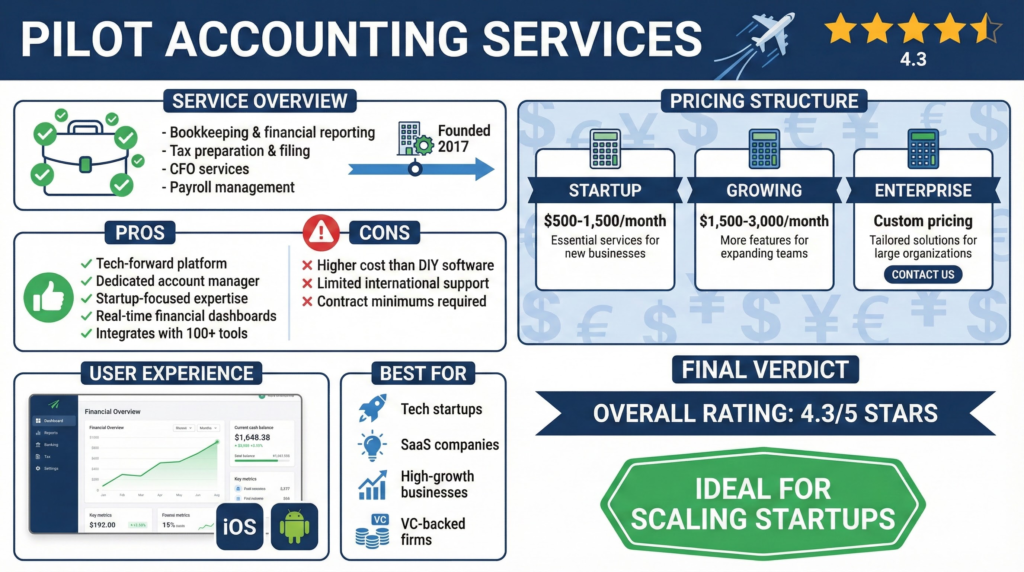
Meta Description
Explore our detailed pilot review of Pilot.co, the bookkeeping service designed to help startups and small businesses achieve financial clarity, save time, and avoid costly errors. Uncover features, performance, pros, cons, and value to see if Pilot is the right partner for your business growth.
Introduction
Running a small business in today’s competitive landscape often means wearing multiple hats, from sales and marketing to operations and finance. For solo entrepreneurs, freelancers, e-commerce and dropshipping store owners, small brick-and-mortar businesses, and early-stage startup founders, this juggling act can be overwhelming. The high costs and complexities of hiring a full-time in-house bookkeeper or accountant, the constant worry over potential tax filing errors or missed deductions with DIY approaches, and the sheer time drain of managing books that results in financial disorganization and obscured cash flow—these are all too common pain points.
Pilot.co emerges as a specialized solution that addresses these issues head-on. As an online bookkeeping and financial services provider, Pilot combines expert human oversight with intelligent software to deliver accurate, compliant financial management. Targeted at tech-savvy professionals aged 25-60 with revenues between $50k and $250k, or those managing local retail, online sales channels, or scalable back-office needs, Pilot has supported over 2,500 growth-oriented businesses. Services include bookkeeping, tax preparation, and advisory, with a focus on startups and small enterprises. As of early 2026, Pilot continues to operate smoothly, with no major disruptions reported in recent reviews.
This pilot review will break down how Pilot’s offerings—backed by user feedback, official details, and performance data—support business owners in regaining control of their finances, avoiding tax risk, and focusing on growth. Use these insights to decide if Pilot aligns with your financial goals.
Take control of your finances—sign up for Pilot now and let expert bookkeeping move your business forward.
Features Overview
Pilot.co stands out by blending automation with professional expertise, offering a range of features designed to simplify financial oversight for small businesses.
Core Bookkeeping Services
At the heart of Pilot is its accrual-basis bookkeeping, which integrates with QuickBooks Online to pull data from bank accounts, credit cards, payroll, and payment platforms like Stripe and Gusto. Users receive monthly financial statements, including profit and loss, balance sheets, and cash flow reports, all prepared by a dedicated bookkeeper. This setup ensures IRS compliance and helps identify inefficiencies, such as hidden expenses or cash flow gaps. Additional tools, such as Reviewbot, perform initial transaction checks to ensure accuracy, reducing errors that could lead to tax issues.
Tax and Advisory Add-Ons
Pilot offers tax services starting at $2,450 per year for unprofitable C-corporations, covering preparation, filing, and R&D tax credit support for tech and e-commerce. CFO services provide tailored budgeting, forecasting, and growth guidance. Add-ons help catch missed deductions and give year-round support to prevent costly errors.
Platform and Integrations
The user portal is intuitive, featuring dashboards that provide real-time insights into metrics such as expense trends and KPIs. Integrations include Expensify for expense tracking, HR software for payroll, and inventory systems, making it seamless for e-commerce owners managing multiple channels. Communication with your bookkeeper is via the portal or email, with monthly phone reviews available in higher tiers.
Specialized Tools
Pilot features cash flow scenario modeling and burn-rate calculations, useful for startups courting investors or planning expansions. Pre-revenue discounts and onboarding help early founders transition smoothly, without paperwork overload.
These features uniquely position Pilot as an end-to-end solution for business owners overwhelmed by financial tasks, delivering time savings, increased accuracy, and scalable support that adapts as your business grows.
Performance Analysis
Evaluating a Pilot’s performance involves looking at its reliability, speed, and effectiveness based on user experiences and service delivery.
Accuracy and Compliance
Pilot delivers accurate, compliant books; users praise bookkeepers for catching errors and ensuring tax readiness. The accrual approach provides a detailed financial picture, which is useful for startups’ fundraising. Some note that monthly closings delay insights, making it less ideal for real-time needs. Recent reviews highlight ongoing accuracy and proactive issue-flagging.
Speed and Efficiency
Onboarding can take up to three months, which some users find lengthy, but once set up, monthly reports are delivered consistently. Response times from bookkeepers are generally prompt, within a business day, aiding in quick resolutions. For time-strapped entrepreneurs, this hands-off approach saves hours, though the lack of daily updates is a notable drawback for fast-paced operations like dropshipping.
Scalability and Adaptability
Pilot supports growing businesses by managing entities and driving international growth in higher plans. It suits startups switching from DIY, offering scaled advice as revenue climbs. For very simple setups, Pilot may feel overbuilt; rigid annual billing also challenges businesses with fluctuating revenue.
Overall, Pilot’s performance is solid for compliance-focused users but may require patience during setup and acceptance of monthly cadences.
Boost your financial efficiency—start with Pilot today for hassle-free bookkeeping and peace of mind.
Pros and Cons
Pilot has garnered positive feedback, but like any service, it has trade-offs.
Pros
- Dedicated Expert Support: Assigned bookkeepers provide personalized, proactive assistance, reducing tax error risks.
- Comprehensive Integrations: Seamless with QuickBooks, Stripe, Gusto, and more, ideal for e-commerce and multi-channel management.
- Strategic Insights: Tools like cash flow modeling and R&D credits add value for growth-oriented startups.
- User-Friendly Portal: Intuitive dashboards make financial data accessible without deep expertise.
- Compliance Focus: Ensures IRS-ready books, alleviating fears of deductions and filings.
Cons
- Lengthy Onboarding: Can take 1-3 months, delaying full benefits.
- Monthly Reporting Only: Lacks real-time tracking, which may hinder cash flow visibility for some.
- Annual Prepayment Required: Rigid billing structure, potentially less flexible for variable revenues.
- Higher Pricing for Scale: Costs rise with expenses, making it pricey for larger small businesses.
- Limited Customization: Some users desire more tailored reports or faster adaptations.
These elements make Pilot a strong contender for strategic needs, but less so for budget-conscious or real-time focused users.
User Experience
Users generally report a positive experience with Pilot, emphasizing its ease of use and supportive structure.
The onboarding, while potentially extended, is guided by a dedicated bookkeeper who handles integrations and setup, minimizing user effort. Once live, the portal’s clean design makes it easy to navigate reports and dashboards, even for non-finance experts like freelancers or retail owners. Communication is seamless via email or the app, with quick responses fostering a collaborative feel.
For tech-savvy audiences, the experience feels empowering, with tools that provide clarity on finances without constant involvement. However, those preferring immediate control might find the monthly cycle limiting. In the recent 2026 feedback, the service remains reliable, with high satisfaction in support and portal usability.
Overall, Pilot delivers a streamlined, professional user experience tailored to busy entrepreneurs.
Get expert tax support and peace of mind—join Pilot today and confidently streamline your tax prep.
Value for Money
Pilot’s pricing is tiered by monthly expenses, starting at $199/month for basic bookkeeping and scaling to $899/month for Core plans with advanced features. Tax add-ons begin at $2,450/year, and CFO services add further costs. While billed annually, this structure offers predictability, and pre-revenue discounts make it accessible for startups.
Compared to hiring in-house (often $40k+ yearly), Pilot provides strong value through time savings and error reduction, directly tackling pain points like cash flow blindness. Users highlight the ROI in accurate reports and strategic advice, especially for growth phases. However, for simpler needs, competitors like Bench at $299/month may be more affordable.
In this analysis, Pilot’s value is evident for businesses that prioritize expert guidance, time efficiency, and accurate financial oversight over lowest cost, yielding substantial gains in productivity, compliance, and clarity.
Unlock tailored bookkeeping—secure your Pilot plan now and experience cost-effective, professional financial support.
Final Verdict
Pilot.co proves to be a robust bookkeeping and financial partner for small businesses and startups tackling financial management hurdles. With dedicated experts, intuitive tools, and comprehensive services, Pilot reduces hiring costs, minimizes tax risk, and saves valuable time—providing clear financial insights that drive growth and peace of mind. Recent reviews affirm its reliability in 2026, with strong performance in accuracy and support.
That said, the service shines brightest for growth-focused users who can accommodate the onboarding timeline and pricing structure. For those with simpler or real-time needs, alternatives might be more suitable. If Pilot aligns with your scalable, cost-effective back-office goals, it’s a worthwhile investment.
Transform your finances today—[ Start with Pilot now for seamless tax and bookkeeping integration.]